Writing a decision memo for your audience
Write a concise recommendation that makes the decision, trade-off, uncertainty, and next action clear.
Write a concise recommendation for a named audience, with alternatives, evidence, assumptions, principal risk, next action, and a useful supporting chart.
Overview
A support manager at established software company Cedar Systems has two proposals for reducing customer delays. The director must choose by Friday. A long account of meetings and research would leave the director searching for the decision.
Both businesses, figures, and policies in this lesson are fictional teaching assumptions.
Recall Lesson 018: What safeguard could reduce the risk that a writer presents only evidence favoring a preferred option?
Write for the reader
A decision memo is a short document that helps a named person make a specific choice.
Identify what the reader can authorize and what they need to judge. Harvard Kennedy School's memo guidance starts with the audience's job, constraints, and tools for addressing the problem. That principle applies to business decisions too. Source
An owner needs costs and customer consequences; an implementing team leader also needs assignments. Adapt detail while keeping the facts consistent.
Begin with the action and approval deadline. Then explain why it is preferable to a genuine alternative. “Approve a four-week routing trial for $1,000 by Friday” gives the reader a concrete request.
Show your reasoning
Use a compact sequence: recommendation, comparison, assumptions and risk, then implementation.
Evidence is information supporting a claim. An assumption is something the recommendation depends on but has not established. Label estimates clearly.
The principal risk is the most important way the plan could fall short. Explain its consequence and a practical response. “Results may vary” gives the reader little help; “Routing may overwhelm specialists, so review their queues daily” connects uncertainty to action.
Give the strongest reason for the alternative and a fact that could change your choice. Preserve evidence that challenges your recommendation.
Close with who will act, what they will do, and when results will be reviewed.
Worked example
Cedar's last 100 support requests included 24 still unresolved after two business days. Every request had the full two-day observation period. The director wants no more than 12 per 100 over a four-week trial, without reducing answer quality.
The manager supplies these untested estimates. Either trial can start Monday, fits available staffing, and requires only the stated one-time payment before starting. There is $1,200 available after existing obligations and no continuing commitment.
| Choice | Additional trial cost | Unresolved after two days, per 100 requests |
|---|---|---|
| Current approach | $0 | 24 observed |
| Refresher training | $600 | 18 estimated |
| Route requests by specialist skill | $1,000 | 10 estimated |
Routing costs $1,000 − $600 = $400 more than training. It is estimated to leave 18 − 10 = eight fewer requests unresolved per 100. Routing is the only proposed trial estimated to meet the target of 12.
View the supporting chart: unresolved requests per 100
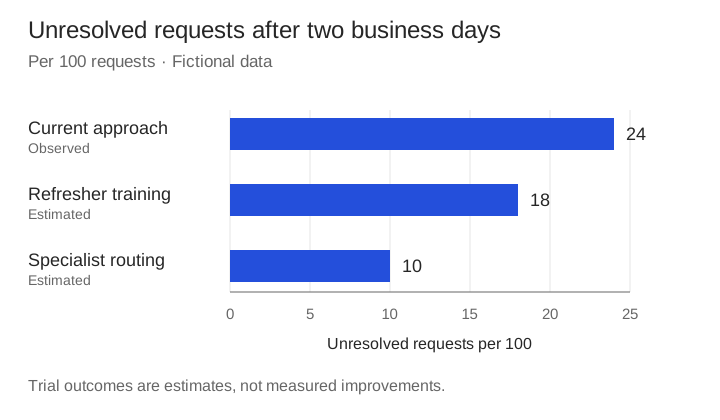
Start the bar chart at zero, label the unit and observation period, and distinguish results from estimates. Keep dollars and request counts on separate scales.
To the support director: Approve the $1,000 routing trial by Friday. It is estimated to reduce requests unresolved after two business days from 24 to 10 per 100, meeting the target of no more than 12. Training costs $400 less but is estimated to leave 18 unresolved.
Routing assumes mismatched assignments cause much of the delay. Its main risk is overloading specialists. I will check delayed-request records before launch, review specialist queues daily, and assess resolution times and answer quality after four weeks. If specialist capacity is inadequate, I will return with a revised proposal before spending.
Exercise
Allow 8–10 minutes. You manage Moss Pet Grooming for its owner, Lena. Of the last 100 booked appointments, 12 customers did not attend or cancel in advance. All appointment dates have passed. Lena wants no more than six such missed appointments per 100 during the next four weeks.
You must choose by Thursday. A text-reminder trial costs $180 and is estimated to reduce missed appointments to eight per 100. A telephone-confirmation trial costs $360 and is estimated to reduce them to five. Both can start Monday; their total additional costs include setup and labor. Lena has $400 available, payable before the trial. Neither requires a continuing commitment.
The estimates assume customers forget appointments. The receptionist reports that some customers instead struggle with transport. Telephone calls could also interrupt service to customers arriving at the shop.
- Write a 120–170-word memo to Lena recommending one trial. Include both options, evidence, an assumption, the principal risk, and a named next action with a review date.
- Sketch a bar chart with three bars: the observed baseline and the two estimated results. Label the unit, start at zero, and state what the chart cannot tell Lena.
- Identify one finding that would make you reconsider the recommendation.
Your memo and chart form this week's deliverable.
Answer
Lena, approve the $360 telephone-confirmation trial by Thursday for the next four weeks. Of our last 100 appointments, 12 were missed without advance cancellation. Calls are estimated to reduce this to five, meeting your limit of six. Text reminders cost $180 less but are estimated to leave eight missed appointments.
The estimate assumes forgetting is a major cause. Before spending, I will review booking records and ask the receptionist about transport problems. The main operating risk is interrupting service at arrival; I will schedule calls outside busy arrival periods and check customer waiting times.
I will review missed appointments per 100 and arrival waiting times each week, with a final review after week four. If transport explains most missed appointments, or calls cannot fit without worsening service, I will bring you a revised recommendation before committing.
The trial leaves $400 − $360 = $40 of the supplied budget. It costs $180 more than texts for an estimated three fewer missed appointments per 100. Without the financial value of those appointments, we cannot claim the extra cost pays for itself.
Your chart should show 12 observed, eight estimated with texts, and five estimated with calls. The chart does not establish causation, profitability, or reliability of the estimates. Keep costs visible in the memo.
Texts could be defensible if calls disrupt service, but their estimate misses Lena's target. Explain that trade-off.
Recall answer: Agree on comparison criteria beforehand and have someone check contradictory evidence. A memo should preserve the strongest relevant objection to its own recommendation.
Applying this lesson
Check that the reader can identify the choice, reason, uncertainty, and next action. Remove detail that does not help them decide or act.
Sources
Comments
Loading comments…